RADD — CBAP Level (30%)
RADD chiếm 30% trong CBAP — KA quan trọng nhất, chiếm gần 1/3 đề thi. Ở CBAP level, RADD test khả năng advanced modeling, enterprise-level design, và strategic requirement decisions.
6 Tasks trong RADD
Task 1: Specify & Model Requirements
Modeling Technique Selection Guide
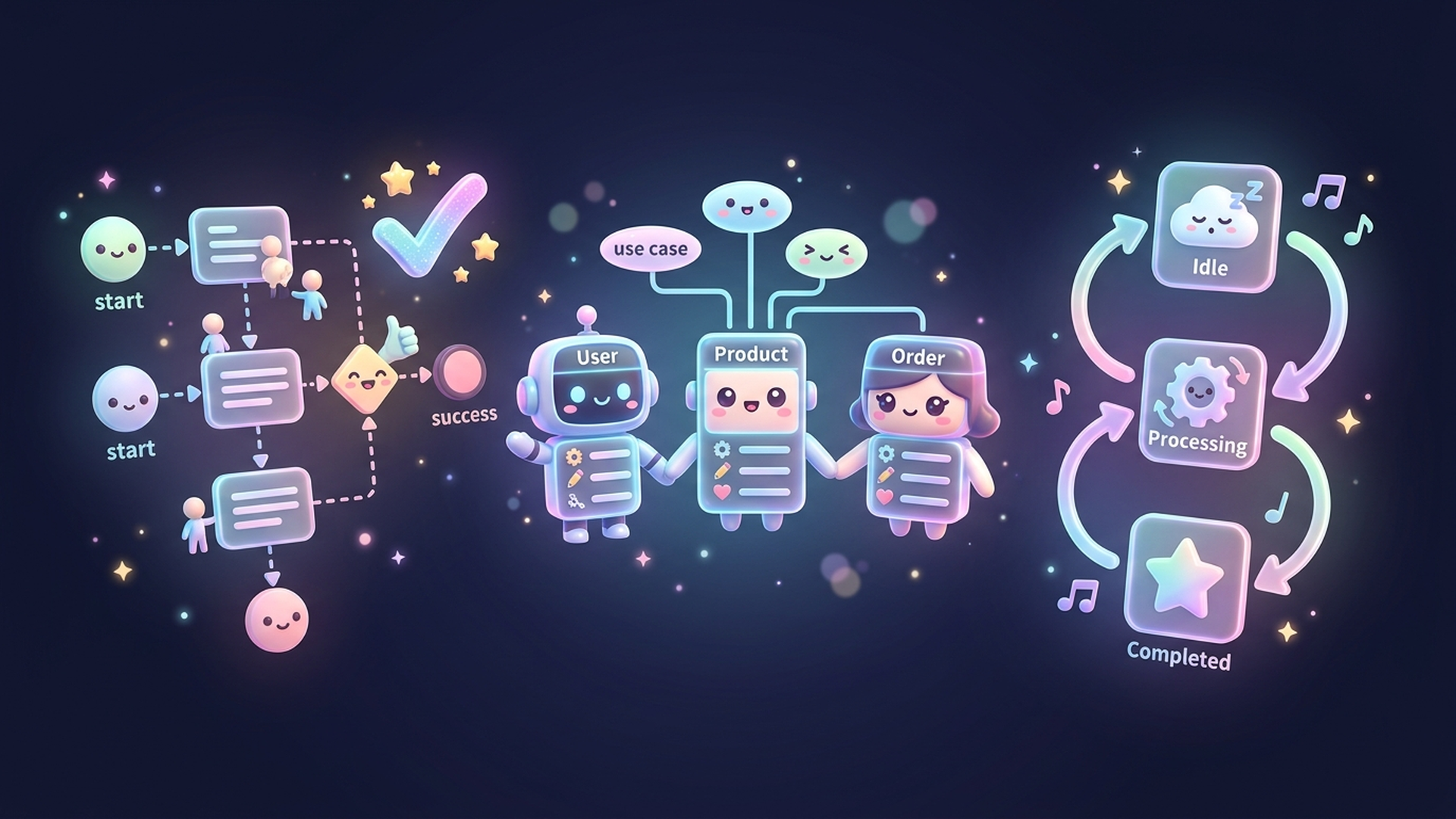
1. BPMN (Business Process Model and Notation)
CBAP-level BPMN đòi hỏi hiểu sâu về pools, lanes, message flows, và sub-processes.
BPMN Element Levels:
| Level | Elements | CBAP Depth |
|---|---|---|
| Basic | Tasks, Gateways, Start/End Events | ✅ Must know |
| Intermediate | Pools, Lanes, Message Events, Sub-processes | ✅ Must know |
| Advanced | Compensation, Error handling, Complex gateways | 🟡 Good to know |
| Executable | Data objects, Service tasks, Script tasks | ⚪ Not tested |
2. ERD (Entity-Relationship Diagram)
Cardinality Rules:
| Symbol | Meaning | Example |
|---|---|---|
| ` | -- | |
||--o\{ | One to Many (optional) | Customer — Orders (0..*) |
||--|\{ | One to Many (required) | Order — OrderLines (1..*) |
| `} | --|{` | Many to Many |
3. Use Case Diagram — Enterprise
Use Case Specification Template
| Element | Content |
|---|---|
| UC ID | UC-001 |
| Name | Place Order |
| Actor | Customer |
| Precondition | Customer logged in, cart not empty |
| Main Flow | 1. Customer reviews cart → 2. Selects shipping → 3. Enters payment → 4. Confirms order → 5. System generates order |
| Alternative Flow | 3a. Payment declined → Show error → Retry |
| Exception Flow | 2a. Item out of stock → Notify → Remove item |
| Postcondition | Order created, confirmation email sent |
| Business Rules | BR-001: Min order $10, BR-002: Free shipping > $50 |
4. State Diagram
5. Decision Table
Business Rule: Discount Calculation
| Condition 1: Customer Type | Condition 2: Order Amount | Condition 3: Season | Action: Discount |
|---|---|---|---|
| VIP | ≥ $1000 | Holiday | 25% |
| VIP | ≥ $1000 | Regular | 20% |
| VIP | < $1000 | Any | 15% |
| Regular | ≥ $1000 | Holiday | 15% |
| Regular | ≥ $1000 | Regular | 10% |
| Regular | < $1000 | Holiday | 10% |
| Regular | < $1000 | Regular | 5% |
| New | Any | Any | 5% |
Decision Table: Best khi nhiều conditions kết hợp, cần đảm bảo completeness (mọi combination đều có action). Decision Tree: Best khi conditions có hierarchy rõ ràng, dễ visualize flow. CBAP có thể hỏi: "Given this business rule, which representation is more appropriate?"
Task 2: Verify Requirements
Verification Checklist
Requirements Quality Attributes
| Attribute | Bad Example ❌ | Good Example ✅ |
|---|---|---|
| Specific | "System should be fast" | "Page load < 2 seconds for 95th percentile" |
| Measurable | "Easy to use" | "New user completes task in < 5 minutes without help" |
| Consistent | "All users can view AND only admins can view" | "Admins can view all data; users can view own data" |
| Feasible | "100% uptime" | "99.9% uptime (8.76 hours downtime/year)" |
| Testable | "System should handle heavy load" | "System supports 10,000 concurrent users" |
| Atomic | "System shall allow login and manage profile" | "FR-001: System shall allow login. FR-002: System shall allow profile management." |
Verification Techniques
| Technique | How It Works | Best For |
|---|---|---|
| Peer Review | Another BA reviews specifications | Catching omissions, ambiguity |
| Walkthrough | Author presents to reviewers | Complex requirements understanding |
| Inspection | Formal review with checklist | Critical/regulated requirements |
| Prototyping | Build mockup to verify understanding | UI/UX requirements |
| Modeling | Create models to verify consistency | Data & process requirements |
Task 3: Validate Requirements
Verify vs Validate
Validation Techniques
| Technique | Description | CBAP Level |
|---|---|---|
| Structured Walkthrough | Walk stakeholders through requirements | Validate understanding |
| Prototyping | Interactive prototype review | Validate UX/workflow |
| Acceptance Criteria Review | Review pass/fail criteria | Validate testability |
| Day-in-the-Life Testing | Simulate real usage scenario | Validate completeness |
| Business Rules Validation | Test rules with real data scenarios | Validate correctness |
Đây là câu bẫy phổ biến nhất trong CBAP exam. Verify = check quality (BA có thể tự làm). Validate = check business value (PHẢI có stakeholder). Nếu câu hỏi nói "check with stakeholder" → Validate. Nếu nói "check for completeness/consistency" → Verify.
Non-functional Requirements (NFRs)
NFR Categories — Enterprise Level
| Category | Sub-types | CBAP Example |
|---|---|---|
| Performance | Response time, Throughput, Latency | "API response < 200ms for 99th percentile" |
| Reliability | Availability, MTBF, MTTR | "99.9% uptime, MTTR < 30 minutes" |
| Security | Authentication, Authorization, Encryption | "Multi-factor authentication for admin functions" |
| Scalability | Vertical, Horizontal, Data volume | "Support 10x current user base without architecture change" |
| Usability | Learnability, Accessibility, Efficiency | "WCAG 2.1 AA compliance" |
| Maintainability | Modularity, Testability, Modifiability | "New module deployment without system restart" |
| Portability | Adaptability, Installability | "Support major browsers, iOS 15+, Android 12+" |
| Compliance | Regulatory, Standards, Audit | "GDPR compliant, SOC 2 Type II certified" |
NFRs thường quyết định kiến trúc giải pháp. "99.99% availability" → cần redundancy, failover. "10,000 concurrent users" → cần horizontal scaling. BA phải elicit NFRs sớm để architect có thể design phù hợp.
Câu hỏi CBAP thường gặp về RADD (Part 1)
Scenario 1
BA document: "System shall display order information quickly and efficiently." QA nói requirement không testable. BA nên:
A. Add test: "QA verify system displays order info"
B. Rewrite: "System shall display order details within 2 seconds of request" ✅
C. Remove requirement
D. Ask stakeholder to define "quickly"
Scenario 2
BA cần model một process phức tạp với 3 departments, message passing, và error handling. Technique tốt nhất:
A. Flowchart
B. Use Case Diagram
C. BPMN with pools, lanes, and message events ✅
D. State Diagram
Scenario 3
Validation session với stakeholders reveals requirement bị miss. BA nên:
A. Add requirement, re-verify, trace to business objective ✅
B. Skip vì đã pass verification
C. Add to next phase
D. Create change request
📝 Tóm tắt kiến thức nổi bật
- RADD ở CBAP chiếm 30% — vẫn là KA lớn nhất, nhưng ở level enterprise modeling
- Advanced BPMN: Pools, lanes, sub-processes, error events, compensation, message flows
- ERD with Mermaid: Entity relationships (1:1, 1:N, M:N), attributes, inheritance
- Use Case Specification: Preconditions → Main Flow → Alternative Flows → Exception Flows → Postconditions
- Verify vs Validate: Verify = quality check (correct, complete, consistent, testable) → Validate = business fit
- NFR Categories: Performance, Security, Availability, Scalability, Usability, Maintainability, Compliance
- Model selection depends on context: data model (ERD), process model (BPMN), behavior model (State/Use Case)
📋 Bài kiểm tra trắc nghiệm — Bài 8
Làm 10 câu bên dưới trong 17 phút. Đáp án ở cuối bài.
Câu 1. Enterprise integration: 3 systems need to share customer data. BA needs to model the data structure across systems. Best model:
- A. BPMN process diagram
- B. Enterprise Data Model (ERD across systems showing shared entities)
- C. Use Case Diagram
- D. State Diagram
Câu 2. Use Case specification has "Main Flow" and "Alternative Flow". The difference:
- A. No difference
- B. Main Flow = happy path (normal); Alternative Flow = valid but different path (still reaches goal)
- C. Alternative Flow = error scenarios only
- D. Main Flow is optional
Câu 3. BA discovers requirement REQ-101 is "Complete" and "Correct" but fails "Consistent" check. This means:
- A. Requirement is fine
- B. REQ-101 contradicts another requirement — needs to be resolved
- C. Requirement needs more detail
- D. Requirement failed validation
Câu 4. BPMN Sub-process is used when:
- A. Process is too simple
- B. A complex portion of a process needs to be encapsulated and potentially reused
- C. Process has no activities
- D. Only for manual processes
Câu 5. NFR: "System must encrypt all data at rest and in transit using AES-256." This drives which design decision?
- A. Database schema design
- B. Security architecture — encryption layers, key management, SSL/TLS configuration
- C. UI design
- D. Process flow design
Câu 6. BA needs to model an entity (Insurance Claim) that goes through states: Filed → Under Review → More Info Needed → Approved/Denied → Closed. Best model:
- A. ERD
- B. BPMN
- C. State Machine Diagram
- D. Use Case Diagram
Câu 7. Verification checklist item: "Is the requirement testable?" Requirement: "System should be user-friendly." Result:
- A. Pass — user-friendly is testable
- B. Fail — "user-friendly" is subjective, not measurable, not testable
- C. Pass — with surveys
- D. Not applicable
Câu 8. Enterprise has 20 APIs for different services. BA needs to model how they interact. Best model:
- A. ERD
- B. System Integration Diagram / Interface Map
- C. State Diagram
- D. Decision Table
Câu 9. Exception Flow in Use Case means:
- A. Regular path
- B. Error handling path — when something goes wrong and system needs to recover
- C. Alternative happy path
- D. Admin-only path
Câu 10. BA finished modeling. Stakeholder says "I don't understand the ERD." BA should:
- A. Explain database concepts
- B. Create alternative visualization (simpler diagram or natural language description) appropriate for stakeholder's level
- C. Skip stakeholder review
- D. Remove ERD from documentation
🔑 Đáp án & Giải thích
| Câu | Đáp án | Giải thích |
|---|---|---|
| 1 | B | Cross-system data sharing → Enterprise Data Model showing shared entities and relationships. |
| 2 | B | Main Flow = normal path. Alternative Flow = valid variation. Exception Flow = error/failure. |
| 3 | B | Fails Consistent = contradicts another requirement. BA must investigate and resolve conflict. |
| 4 | B | Sub-process = encapsulate complex portion. Enables modularity and reuse. |
| 5 | B | Encryption NFR → security architecture decisions: encryption algorithms, key management, TLS. |
| 6 | C | Entity with lifecycle states → State Machine Diagram is ideal. |
| 7 | B | "User-friendly" is subjective → not testable. Should be "Task completion rate > 90% by first-time users." |
| 8 | B | Multiple APIs interacting → System Integration / Interface Map shows connections and data flows. |
| 9 | B | Exception Flow = error handling, unexpected situations, system recovery. |
| 10 | B | Adapt communication to audience — create appropriate visualization for non-technical stakeholders. |
📊 Thang đánh giá
| Số câu đúng | Đánh giá | Hành động |
|---|---|---|
| 9-10 | ⭐ Xuất sắc | RADD Part 1 enterprise level nắm vững! |
| 7-8 | ✅ Tốt | Ôn lại Use Case specification và NFR-to-design mapping |
| 5-6 | ⚠️ Trung bình | RADD 30% — cần ôn model selection và verification |
| < 5 | ❌ Cần ôn lại | RADD quyết định pass/fail — invest heavily here |
Tiếp theo: RADD nâng cao — Phần 2: Solution Design & Architecture 👉