Solution Evaluation — CBAP Level (14%)
Solution Evaluation chiếm 14% trong CBAP (tăng đáng kể từ 6% trong CCBA). Đây là KA yêu cầu strategic evaluation — đánh giá giải pháp không chỉ ở mức "có hoạt động không" mà ở mức "có tạo ra giá trị enterprise-level không".
5 Tasks trong SE
Task 1: Measure Solution Performance
KPI Framework Design
Measurement Design — SMART Metrics
| Element | Description | CBAP Example |
|---|---|---|
| Specific | Clear what is being measured | "Average order processing time" not "speed" |
| Measurable | Quantifiable | "47 minutes" not "fast" |
| Achievable | Realistic target | "50% reduction" not "100% reduction" |
| Relevant | Connected to business objective | Processing time → customer satisfaction |
| Time-bound | When to measure | "By Q4 2026" with monthly tracking |
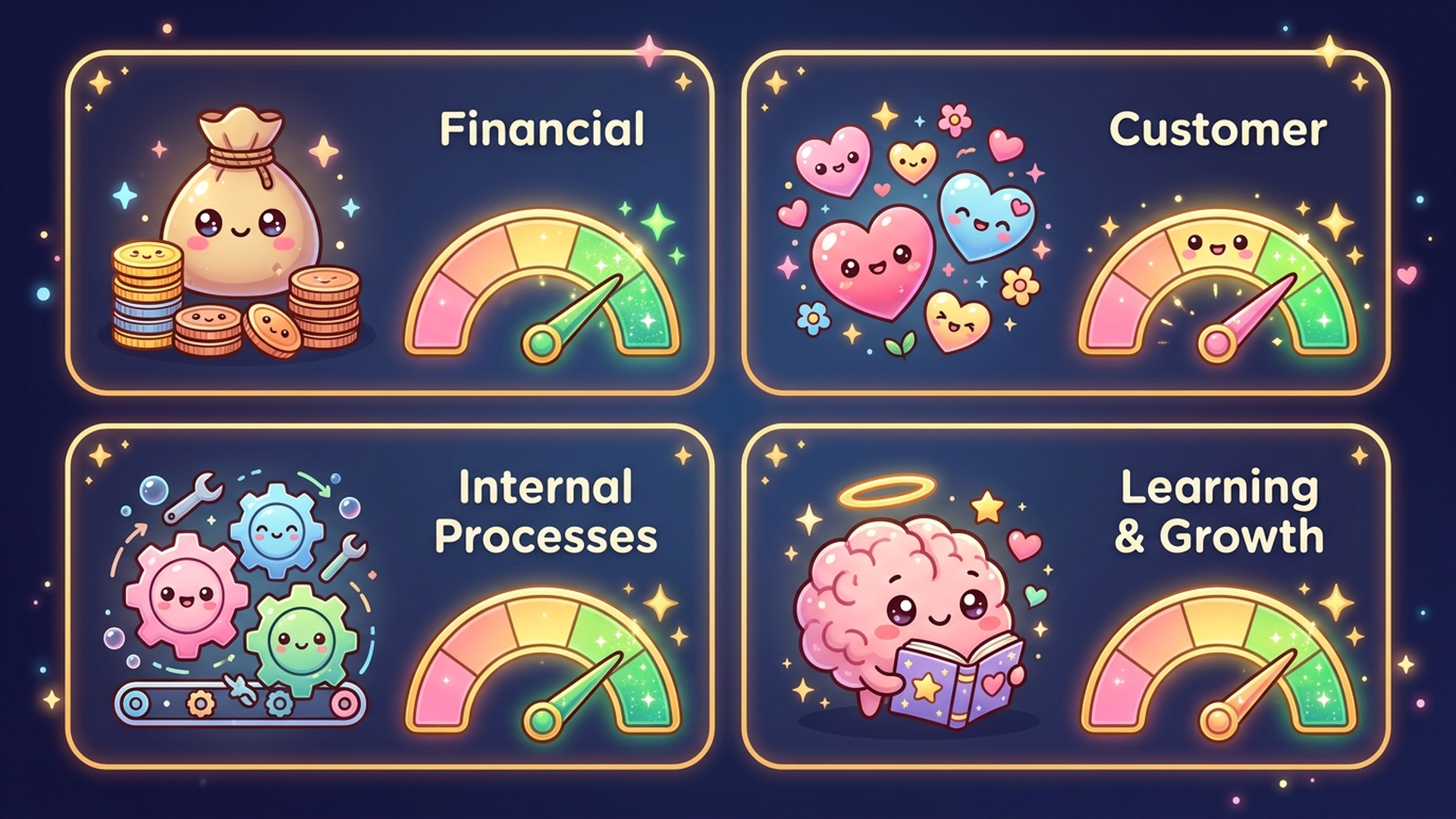
Balanced Scorecard for Solution Evaluation
| Perspective | KPI | Baseline | Target | Actual | Status |
|---|---|---|---|---|---|
| Financial | ROI | 0% | 30% | 25% | 🟡 |
| Customer | NPS | 45 | 70 | 72 | 🟢 |
| Process | Cycle time | 48h | 12h | 8h | 🟢 |
| Learning | Adoption rate | 0% | 90% | 65% | 🔴 |
Task 2: Analyze Performance Measures
Performance Analysis Framework
Variance Analysis
| KPI | Target | Actual | Variance | Analysis |
|---|---|---|---|---|
| Processing time | 12h | 8h | +33% ✅ | Over-performing, possible further optimization |
| Adoption rate | 90% | 65% | -28% ❌ | Under-performing, needs intervention |
| Error rate | <2% | 3.5% | -43% ❌ | Process issue, needs root cause analysis |
| Cost savings | $200K | $180K | -10% 🟡 | Close to target, monitor |
Measurement = collecting data. Analysis = interpreting data to make decisions. CBAP tests analysis — "Given these metrics, what does it tell us? What should BA recommend?"
Task 3: Assess Solution Limitations
Solution Limitations Assessment
Limitation Impact Assessment
| Limitation | Affected Stakeholders | Business Impact | Severity | Workaround? |
|---|---|---|---|---|
| No multi-currency | International customers | Revenue loss ~$500K/year | 🔴 High | Manual conversion (costly) |
| Slow at 5000+ users | All users during peak | Productivity loss | 🟡 Medium | Stagger usage times |
| No mobile app | Field sales team | Competitive disadvantage | 🟡 Medium | Mobile browser (poor UX) |
| Complex workflows | New employees | Extended onboarding | 🟢 Low | Training program |
Task 4: Assess Enterprise Limitations
Enterprise Limitations — Beyond the Solution
Solution vs Enterprise Limitations
| Issue | Solution Limitation? | Enterprise Limitation? | BA Action |
|---|---|---|---|
| System can't handle 10K users | ✅ | Spec upgrade requirement | |
| Users don't use the system | ✅ | Change management | |
| Data is inaccurate | ✅ | Data governance program | |
| Missing feature X | ✅ | Enhancement request | |
| Teams don't share information | ✅ | Organizational change | |
| System crashes under load | ✅ | Performance fix |
Đây là điểm khác biệt quan trọng nhất ở CBAP level. CCBA test solution limitations (hệ thống thiếu gì). CBAP test enterprise limitations (tổ chức thiếu gì) — vì giải pháp hoàn hảo cũng thất bại nếu tổ chức chưa ready.
Task 5: Recommend Actions to Increase Solution Value
Action Categories
Decision Framework: What to Recommend
Benefits Realization Plan
| Benefit | Metric | Baseline | Target | Timeline | Owner | Status |
|---|---|---|---|---|---|---|
| Revenue growth | MRR | $500K | $600K | Q2 2026 | Sales VP | 🟡 Track |
| Cost reduction | COGS | $300K/mo | $200K/mo | Q3 2026 | Ops Director | 🟢 On track |
| Adoption | Active users | 40% | 90% | Q4 2026 | Change Lead | 🔴 At risk |
| Satisfaction | NPS | 45 | 70 | Q1 2027 | Product Owner | 🟢 On track |
Continuous Value Optimization
Câu hỏi CBAP thường gặp về SE
Scenario 1
Giải pháp deployed 6 tháng. Revenue tăng 15% (target 20%), nhưng customer satisfaction tăng từ NPS 45 lên 75 (target 70). BA nên:
A. Report as failure (revenue miss)
B. Report balanced view: NPS exceeded, revenue improving — analyze why revenue gap ✅
C. Report as success (NPS exceeded)
D. Wait thêm 6 tháng
Scenario 2
User adoption chỉ 40% sau 3 tháng triển khai. Technical metrics đều đạt (performance, uptime). BA identify root cause:
A. Enterprise limitation: lack of change management & training ✅
B. Solution limitation: missing features
C. Technical limitation: slow system
D. Project failure
Scenario 3
Solution 5 năm tuổi, maintenance cost tăng mỗi năm, vendor end-of-life in 2 years. Business value still positive. BA nên:
A. Continue until end-of-life
B. Start planning replacement NOW with transition strategy ✅
C. Negotiate vendor extension
D. Build internal replacement
Scenario 4
BA phát hiện solution limitations nhưng cũng find enterprise limitations. BA nên address nào trước?
A. Solution limitations (easier to fix)
B. Enterprise limitations (bigger impact)
C. Both in parallel: solution fixes + organizational changes ✅
D. Let management decide order
Solution Evaluation ở CBAP = Strategic value assessment + Enterprise-level analysis + Continuous optimization. BA không chỉ đo "hệ thống có chạy không" mà đo "tổ chức có nhận được VALUE không". Và khi value thiếu, phân biệt rõ: do solution hay do enterprise.
📝 Tóm tắt kiến thức nổi bật
- Solution Evaluation chiếm 14% CBAP — significant increase from CCBA (6%)
- 5 Tasks SE: Measure Solution Performance → Analyze Performance Measures → Assess Solution Limitations → Assess Enterprise Limitations → Recommend Actions
- Solution Performance = actual value delivered vs expected value (KPIs, metrics, Balanced Scorecard)
- Solution Limitations = issues within the solution itself (bugs, usability, performance bottlenecks)
- Enterprise Limitations = issues in the organization preventing solution success (culture, process, skills gap)
- Recommend Actions: Replace, Improve, Retire, Do Nothing — phải justify với ROI và strategic alignment
- Balanced Scorecard: Financial + Customer + Internal Process + Learning & Growth — 4 perspectives evaluation
- CBAP: BA proactively identifies improvement opportunities, not just reports problems
📋 Bài kiểm tra trắc nghiệm — Bài 10
Làm 10 câu bên dưới trong 17 phút. Chọn MỘT đáp án đúng nhất.
Câu 1. Solution deployed 6 months ago. KPI: "Reduce order processing time from 48h to 24h." Measured: 36h. Assessment:
- A. Solution thành công hoàn toàn
- B. Partial success — improved 25% nhưng chưa đạt target 50% improvement. BA should investigate root causes of remaining gap
- C. Solution thất bại — cần replace
- D. KPI sai — cần thay đổi target
Câu 2. User satisfaction survey shows 65% satisfaction (target: 80%). Investigation reveals users struggle with UI. This is:
- A. Enterprise limitation
- B. Solution limitation — product usability issue within the solution itself
- C. External market factor
- D. Training issue only
Câu 3. Same scenario, but investigation reveals users weren't trained properly despite training being planned. This is:
- A. Solution limitation
- B. Enterprise limitation — organizational failure to execute training plan
- C. Vendor issue
- D. Budget issue
Câu 4. Balanced Scorecard evaluates solution from 4 perspectives. A reporting dashboard shows high usage (Internal Process), good adoption (Learning & Growth), revenue increase (Financial), but customer complaints increase. Conclusion:
- A. Solution is successful — 3 of 4 positive
- B. Customer perspective failing — BA must investigate complaints, which may undermine long-term financial gains
- C. Ignore complaints
- D. Replace solution immediately
Câu 5. Solution recommendation options: Replace, Improve, Retire, Do Nothing. When is "Do Nothing" appropriate?
- A. Never appropriate
- B. When cost of change exceeds benefit, solution is meeting minimum requirements, and no strategic driver for improvement
- C. When stakeholders are busy
- D. When budget is available
Câu 6. Enterprise deploys new ERP. 3 months later, Finance team uses ERP but Sales team still uses Excel. Root cause analysis:
- A. ERP doesn't have Sales features
- B. Change management failure — Sales team resistance, likely due to insufficient stakeholder engagement and change readiness assessment
- C. Budget issue
- D. Technical incompatibility
Câu 7. BA recommends "Improve" for existing solution. What should the recommendation include?
- A. Just "improve it"
- B. Specific improvement areas, estimated cost, expected value improvement, timeline, risks, and comparison with Replace/Retire alternatives
- C. Only cost estimate
- D. Only technical changes
Câu 8. Solution has high operational costs but delivers strong strategic value. Recommendation assessment:
- A. Retire immediately — too expensive
- B. Analyze total value (strategic + operational) — high costs may be justified if strategic value significantly outweighs them. Consider optimization to reduce costs while maintaining value
- C. Ignore costs
- D. Replace with cheaper solution
Câu 9. Measuring solution performance: BA selects metrics but realizes some KPIs measure output (reports generated) not outcome (decisions improved). CBAP-level approach:
- A. Output metrics are sufficient
- B. Shift focus to outcome metrics — measure actual business impact (decision quality, time-to-decision, revenue from better decisions)
- C. Use both equally
- D. Remove all metrics
Câu 10. Post-implementation review reveals solution meets all original requirements but business environment changed significantly. Market shifted. Best approach:
- A. Solution is successful because it meets requirements
- B. Requirements were correct at the time but are now outdated — reassess solution value against CURRENT business needs, potentially triggering new initiative
- C. Blame requirements team
- D. Continue as planned
🔑 Đáp án & Giải thích
| Câu | Đáp án | Giải thích |
|---|---|---|
| 1 | B | 36h vs target 24h: improved but gap remains. Investigate root causes like process bottlenecks or integration issues. |
| 2 | B | UI usability = solution limitation — issue within the product itself. |
| 3 | B | Training not executed = enterprise limitation — organizational execution failure. |
| 4 | B | BSC requires ALL 4 perspectives. Customer complaints threaten long-term sustainability. |
| 5 | B | "Do Nothing" is valid when improvement cost > benefit and minimum needs are met. |
| 6 | B | Adoption failure = change management issue. Technical solution works but people don't adopt. |
| 7 | B | Complete recommendation: what, how much, expected value, timeline, risks, alternatives comparison. |
| 8 | B | Total value analysis. Strategic value may justify operational costs. Optimize if possible. |
| 9 | B | CBAP level: outcome metrics > output metrics. Measure actual business impact. |
| 10 | B | Requirements met ≠ value delivered. Business context changed → reassess against current needs. |
📊 Thang đánh giá
| Số câu đúng | Đánh giá | Hành động |
|---|---|---|
| 9-10 | ⭐ Xuất sắc | Solution Evaluation strategic thinking excellent! |
| 7-8 | ✅ Tốt | Ôn lại BSC 4 perspectives và Solution vs Enterprise limitations |
| 5-6 | ⚠️ Trung bình | SE 14% — cần nắm vững outcome vs output metrics |
| < 5 | ❌ Cần ôn lại | Re-study SE tasks và recommendation framework |
Tiếp theo: BA Perspectives — Agile, BI, IT & Architecture 👉